

This issue opens with the second installment of our 2026 V2G Policy Series, examining why predictable, bankable revenue streams remain one of the biggest missing pieces for moving from demonstration projects to durable market offerings. We also look at another critical dimension of the transition: consumer behavior. A new academic study reviewed in this issue explores what motivates EV drivers’ willingness to participate in V2G programs.
Elsewhere, new developments continue to shape the V2G landscape. California has released an important roadmap examining how bidirectional charging could support the state’s evolving grid, while Tesla is preparing to enter the UK retail electricity market with a model that could integrate EVs, home batteries, and dynamic electricity pricing. Together, these signals point to a clear theme: the pathway to scale is becoming clearer, but important market and policy gaps remain.

V2G Insights
Bridge to Scale: Why V2G Needs Bankable Revenue Streams

March 17, 2026
This article is the second in a new V2G News 2026 Policy Series examining the structural barriers that continue to slow the transition of vehicle-to-grid (V2G) from pilots to scalable market offerings. The first installment focused on the importance of enabling grid exports from EVs. This second piece turns to a closely related issue: compensation, and, more specifically, why the absence of long-term, predictable revenue streams remains one of the biggest obstacles to V2G at scale.
V2G can create real system value, and in many places it already does. But value alone is not enough. To unlock private capital, reduce financing costs, and move beyond grant-funded demonstrations, V2G needs compensation structures that look less like temporary programs and more like durable market infrastructure.
Across the U.S., a growing number of utilities and states have created pathways for EVs to earn revenue by providing grid services. Event-based demand response programs, export tariffs, dynamic rates, and virtual power plant pilots now exist in several major markets. Bidirectional EVs have demonstrated meaningful revenue potential, from several thousand dollars per year for light-duty vehicles to well over $10,000 per year for electric school buses in New England.
Yet despite this progress, V2G deployment remains slow and fragmented. One reason is that nearly all existing compensation mechanisms are short-term, conditional, or inherently uncertain.

V2G Intelligence
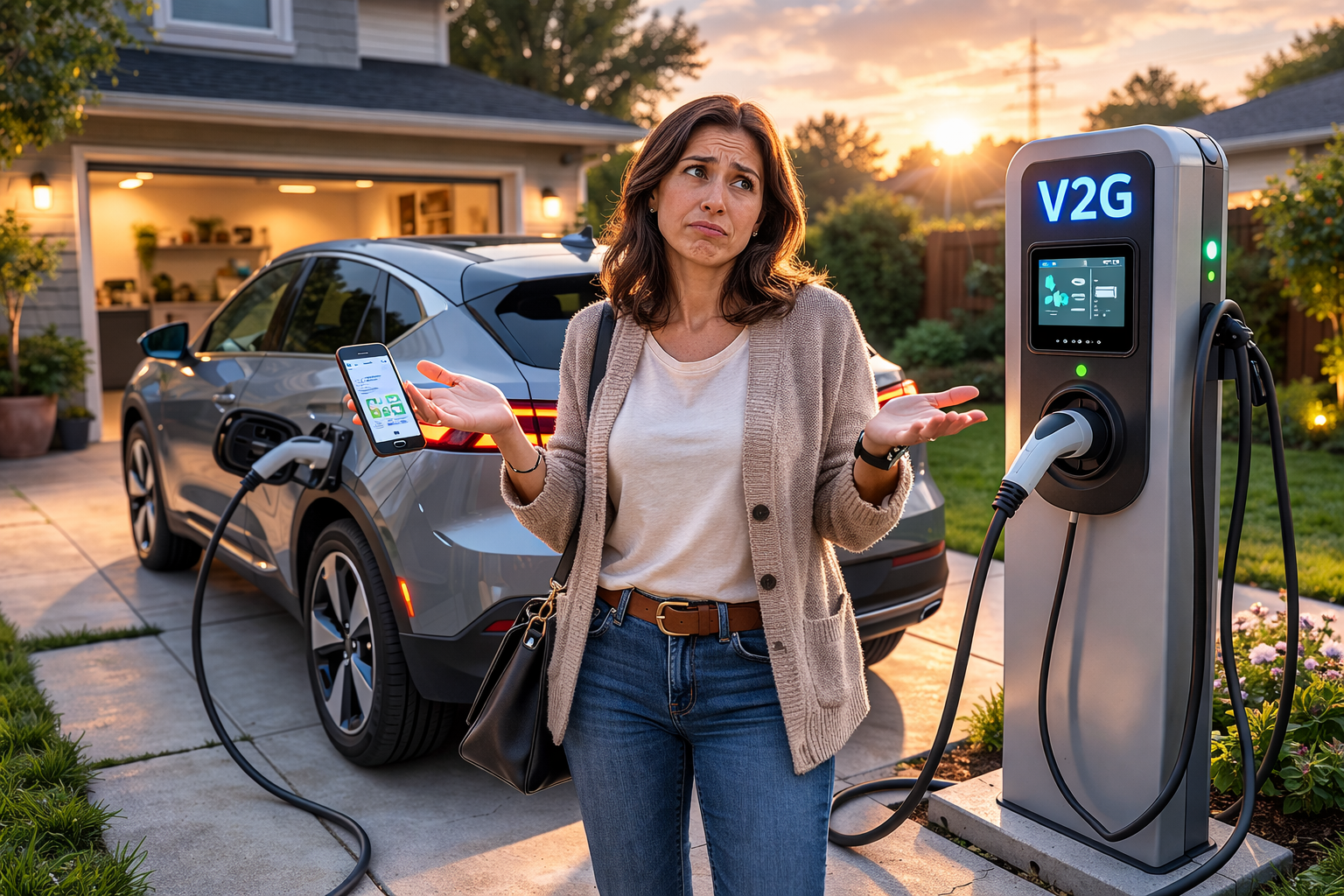
Will Consumers Participate: New Study Highlights the Behavioral Side of V2G Adoption
March 17, 2026
Zhang, C., Takahashi, K., Iwafune, Y., & Shibata, Y. (2025). Understanding user acceptance and behavioral determinants of vehicle-to-grid participation: Evidence from a large-scale survey in Japan. Renewable and Sustainable Energy Reviews, 228, 116603. https://doi.org/10.1016/j.rser.2025.116603.
Much of the vehicle-to-grid literature focuses on engineering feasibility and market economics. Researchers have spent years estimating the value EV batteries can provide to the grid, modeling optimal charging and discharging strategies, and examining how dynamic pricing could unlock arbitrage opportunities.
But there is another question that ultimately determines whether V2G will scale: Will drivers actually participate?
A new study published in Renewable and Sustainable Energy Reviews approaches V2G from this behavioral perspective. Rather than modeling electricity prices or dispatch algorithms, the authors examine how consumer awareness, incentives, and personal circumstances shape willingness to participate in V2G programs.
The results offer an important complement to the economic and operational studies previously reviewed in V2G News. Grid value alone does not ensure deployment. That value can only be realized if drivers are willing to allow their vehicles to participate.
V2G Finds—US
The California Energy Commission released a new roadmap outlining how California can unlock the benefits of bidirectional EV charging as electric vehicle adoption accelerates. The report focuses primarily on the technical and economic potential of vehicle-to-home (V2H) applications while also examining the longer-term role of vehicle-to-grid integration. It identifies remaining barriers and proposes next steps for scaling deployment across the state.
California’s rapidly growing EV fleet already represents a significant energy resource. The number of zero-emission vehicles on California roads topped 2.1 million at the end of 2025, fueled by record sales in the third quarter when more than 29 percent of new cars sold in the state were ZEVs. The average onboard charger power for light-duty battery EVs has reached close to 11 kW, and average battery capacity now exceeds 80 kWh. Collectively, California’s EV fleet represents an estimated 18.5 GW of potential bidirectional power capacity as of 2025, surpassing the total capacity of stationary storage resources statewide. For context, California’s historical statewide peak electricity demand reached 52 GW in September 2022. Because personal vehicles are parked roughly 95 percent of the time, the roadmap highlights their potential to provide backup power to homes and deliver flexible capacity that could support the broader electricity system.
Modeling conducted for the roadmap shows the magnitude of this opportunity. Under a scenario with 4.5 million EVs on California roads by 2030, roughly half could be available to discharge at least once per week. Bidirectional operation from those vehicles could reduce peak demand by 4.1 to 5 GW, representing up to 11.6 percent of residential peak load, while delivering estimated household bill savings of $262 to $321 per vehicle during summer months.
Despite this promise, the report notes that several barriers remain, including high installation costs for bidirectional equipment, vertically integrated hardware ecosystems that limit interoperability, and regulatory frameworks such as Rule 21 that were not designed to accommodate mobile generation assets. The roadmap, therefore, emphasizes non-export V2H configurations as an immediate pathway for deployment while regulators work to develop the standards, compensation structures, and interconnection processes needed to enable larger-scale V2G use cases.
3/5/2026
Commercial EV manufacturer Xos has announced plans to introduce vehicle-to-grid capability across its entire product portfolio beginning in April 2026, starting with a major electric school bus platform operating on tens of thousands of routes across the United States. The move is notable given the limited availability of bidirectional platforms in the medium-duty commercial vehicle segment, a gap that has slowed broader deployment of fleet-based V2G programs. By embedding bidirectional capability directly into new vehicles and depot energy systems, Xos aims to enable fleets such as school districts and delivery operators to export energy during peak demand events, reduce demand charges, and participate in utility demand response programs without requiring hardware retrofits. The announcement highlights the growing recognition that predictable fleet operations and centralized depot charging make medium-duty commercial vehicles particularly well-suited for large-scale V2G applications.
3/10/2026
A recent article from Electrek highlights a growing but still limited group of electric vehicles capable of powering a home through vehicle-to-home technology. While most EVs have batteries large enough to supply household electricity for days, only a handful currently include the hardware and software needed to safely export that energy through a bidirectional charging system du. The list includes well-known examples such as the Ford F-150 Lightning, Kia EV9, Tesla Cybertruck, and several General Motors models that work with the GM Energy home system. Other vehicles, such as the Polestar 3 and Volvo EX90 are beginning to support V2H through partnerships with home energy platforms like dcbel, while the Nissan LEAF continues to offer V2H capability in markets such as Japan and Europe. The article underscores both the promise and the current limitations of bidirectional charging: the capability exists today, but it typically requires dedicated home integration hardware and remains available only on a relatively small number of vehicles focused on the home backup power use case.
3/13/2026
V2G Finds—Global
Tesla is preparing to enter the United Kingdom’s retail electricity market after receiving approval from the energy regulator Ofgem to supply electricity beginning in spring 2026. The move could allow Tesla to leverage its large installed base of roughly 250,000 vehicles and home batteries in the UK to offer integrated energy services that combine electric vehicles, residential storage, and dynamic electricity pricing. Similar to its retail electricity offerings in Texas through Tesla, the company is expected to explore programs that enable EV owners to charge during low-cost periods and potentially export power back to the grid through vehicle-to-grid services. Tesla’s entry would position it against established UK suppliers such as Octopus Energy and British Gas, while also testing whether vertically integrated EV and energy ecosystems can compete in a mature retail electricity market. If successful, the strategy could accelerate the development of EV-enabled virtual power plants and strengthen the role of electric vehicles as distributed energy resources within the UK grid.
3/12/2026
China has taken a significant step toward integrating electric vehicles into the power system with the implementation of its first national technical standard for vehicle-to-grid interactive microgrids. The new standard, which took effect on March 1, establishes technical requirements for key systems supporting bidirectional charging and coordinated operation between EVs, distributed energy resources, and the grid. Developed by State Grid entities in Suzhou and released by the Jiangsu Provincial Society of Electrical Engineering, the framework aims to address interoperability and operational challenges that have emerged as EV adoption accelerates. By providing clear guidance for microgrid design and operation, the standard is expected to support the development of advanced charging infrastructure and enable EVs to participate more effectively in grid flexibility and renewable energy integration.
3/6/2026
BYD New Zealand is recruiting up to ten Atto 3 owners to participate in the country’s first large-scale vehicle-to-grid trial in Queenstown. The 18-month pilot, funded by the Energy Efficiency and Conservation Authority and led by the Queenstown Electrification Accelerator with Rewiring Aotearoa, will test how EV batteries can export electricity back to the grid through bidirectional chargers. The project aims to evaluate the role of EVs in reducing peak demand, lowering electricity costs, and providing backup power during outages. Queenstown’s geographic vulnerability and single transmission line make it an ideal test location for resilience-focused V2G applications. Data from the trial will help inform future deployment, with results expected to be released through 2027.
3/6/2026
A new market forecast from Future Market Insights projects steady growth in the global bidirectional EV charging sector over the next decade as electric vehicles increasingly participate in energy systems. The firm estimates that the market will grow from $2.1 billion in 2025 to $2.3 billion in 2026, eventually reaching $5.8 billion by 2036, representing a 9.7 percent compound annual growth rate. The expansion is being driven by accelerating EV adoption, grid modernization initiatives, and rising interest from utilities in using EV batteries as distributed energy resources. Bidirectional charging systems enable vehicles to both draw electricity from the grid and supply power back during peak demand events, supporting renewable energy integration and demand response programs. The report also highlights growing investment from companies such as Wallbox, Fermata Energy, Nuvve, and The Mobility House, reflecting a broader industry effort to scale bidirectional charging infrastructure as EV batteries become an increasingly important component of future energy systems.
3/11/2026
Enjoying V2G News? Know someone who’d benefit from staying ahead in the fast-moving world of V2G? Twice a month, we deliver expert insights, top headlines, and coverage of the latest innovations—free, straight to their inbox. 👉 Share this link.
